



import torch
import torchvision
from torchvision.models import vgg19, VGG19_Weights
from torch import nn
from d2l import torch as d2l

d2l.set_figsize()
content_img = d2l.Image.open('D:/Code/d2l/d2l/img/loxcy.jpg')
style_img = d2l.Image.open('D:/Code/d2l/d2l/img/OIP-C.jpg')

# 预处理
rgb_mean = torch.tensor([0.485, 0.456, 0.406])
rgb_std = torch.tensor([0.229, 0.224, 0.225])
def preprocess(img, image_shape):
    transforms = torchvision.transforms.Compose([
        torchvision.transforms.Resize(image_shape),
        torchvision.transforms.ToTensor(),
        torchvision.transforms.Normalize(mean=rgb_mean, std=rgb_std)
    ])
    return transforms(img).unsqueeze(0)

# 后处理
def postprocess(img):
    img = img[0].to(rgb_std.device)
    img = torch.clamp(img.permute(1, 2, 0) * rgb_std + rgb_mean, 0, 1)
    return torchvision.transforms.ToPILImage()(img.permute(2, 0, 1))

# 提取图像特征
pretrained_net = vgg19(weights=VGG19_Weights.DEFAULT)

style_layers, content_layers = [0, 5, 10, 19, 28], [25]

# 构建网络,只用保留需要用到的VGG的所有层
net = nn.Sequential(*[pretrained_net.features[i] for i in range(max(style_layers + content_layers) + 1)])

def extract_features(X, content_layers, style_layers):
    contents = []
    styles = []
    for i in range(len(net)):
        X = net[i](X)
        if i in style_layers:
            styles.append(X)
        if i in content_layers:
            contents.append(X)
    return contents, styles

def get_contents(image_shape, device):
    content_X = preprocess(content_img, image_shape).to(device)
    contents_Y, _ = extract_features(content_X, content_layers, style_layers)
    return content_X, contents_Y

def get_styles(image_shape, device):
    style_X = preprocess(style_img, image_shape).to(device)
    _, styles_Y = extract_features(style_X, content_layers, style_layers)
    return style_X, styles_Y

# 定义损失函数
# 1、内容损失
def content_loss(Y_hat, Y):
    return torch.square(Y_hat - Y.detach()).mean()

# 2、风格损失
def gram(X):
    num_channels, n = X.shape[1], X.numel() // X.shape[1]
    X = X.reshape((num_channels, n))
    # 矩阵对自己的内积表示各通道之间的风格特征相关性
    return torch.matmul(X, X.T) / (num_channels * n)

def style_loss(Y_hat, gram_Y):
    return torch.square(gram(Y_hat) - gram_Y.detach()).mean()

# 3、全变分损失
def tv_loss(Y_hat):
    return 0.5 * (torch.abs(Y_hat[:, :, 1:, :] - Y_hat[:, :, :-1, :]).mean() +
                  torch.abs(Y_hat[:, :, :, 1:] - Y_hat[:, :, :, :-1]).mean())

# 4、损失函数
# 风格迁移的损失函数是内容损失、风格损失和全变分损失的加权和
content_weight, style_weight, tv_weight = 1, 1e2, 40

def compute_loss(X, contents_Y_hat, styles_Y_hat, contents_Y, styles_Y_gram):
    # 分别计算内容损失、风格损失和全变分损失
    contents_l = [content_loss(Y_hat, Y) * content_weight for Y_hat, Y in zip(contents_Y_hat, contents_Y)]
    styles_l = [style_loss(Y_hat, Y) * style_weight for Y_hat, Y in zip(styles_Y_hat, styles_Y_gram)]
    tv_l = tv_loss(X) * tv_weight
    # 对所有损失求和
    l = sum(10 * styles_l + contents_l + [tv_l])
    return  contents_l, styles_l, tv_l, l

# 合成图像
class SynthesizedImage(nn.Module):
    def __init__(self, img_shape, **kwargs):
        super(SynthesizedImage, self).__init__(**kwargs)
        self.weight = nn.Parameter(torch.rand(*img_shape))

    def forward(self):
        return self.weight

def get_inits(X, device, lr, styles_Y):
    gen_img = SynthesizedImage(X.shape).to(device)
    gen_img.weight.data.copy_(X.data)
    trainer = torch.optim.Adam(gen_img.parameters(), lr=lr)
    styles_Y_gram = [gram(Y) for Y in styles_Y]
    return gen_img(), styles_Y_gram, trainer

def train(X, contents_Y, styles_Y, device, lr, num_epochs, lr_decay_epoch):
    X, styles_Y_gram, trainer = get_inits(X, device, lr, styles_Y)
    scheduler = torch.optim.lr_scheduler.StepLR(trainer, lr_decay_epoch, 0.1)
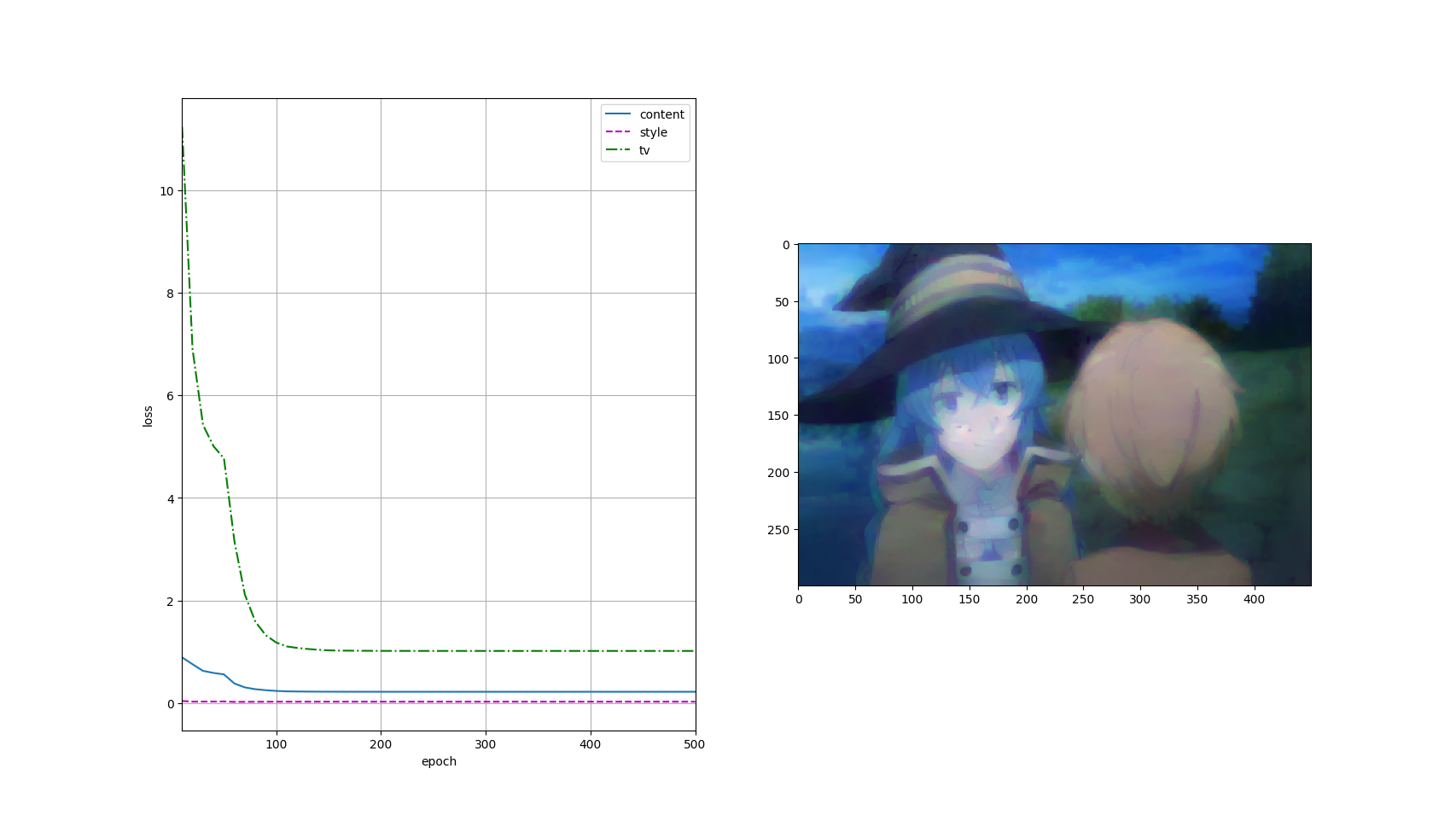
    animator = d2l.Animator(xlabel='epoch', ylabel='loss', xlim=[10, num_epochs],
                            legend=['content', 'style', 'tv'],
                            ncols=2, figsize=(7, 2.5))
    for epoch in range(num_epochs):
        trainer.zero_grad()
        contents_Y_hat, styles_Y_hat = extract_features(X, content_layers, style_layers)
        contents_l, styles_l, tv_l, l =  compute_loss(X, contents_Y_hat, styles_Y_hat, contents_Y, styles_Y_gram)
        l.backward()
        trainer.step()
        scheduler.step()
        if(epoch + 1) % 10 == 0:
            animator.axes[1].imshow(postprocess(X))
            animator.add(epoch + 1, [float(sum(contents_l)), float(sum(styles_l)), float(tv_l)])
    return X

device, image_shape = d2l.try_gpu(), (300, 450)
net = net.to(device)
content_X, contents_Y = get_contents(image_shape, device)
_, styles_Y = get_styles(image_shape, device)
output = train(content_X, contents_Y, styles_Y, device, 0.3, 500, 50)

d2l.plt.show()
© 版权声明
版权声明
- 1本网站名称:MuQYY
- 2本站永久网址:www.muqyy.top
- 3本网站的文章部分内容可能来源于网络,仅供大家学习与参考,如有侵权,请联系站长 微信:bwj-1215 进行删除处理。
- 4本站一切资源不代表本站立场,并不代表本站赞同其观点和对其真实性负责。
- 5本站一律禁止以任何方式发布或转载任何违法的相关信息,访客发现请向站长举报
- 6本站资源大多存储在云盘,如发现链接失效,请联系我们我们会在第一时间更新。
THE END




暂无评论内容