




import math
import torch
from torch import nn
from torch.nn import functional as F
from d2l import torch as d2l

batch_size, num_steps = 32, 35
train_iter, vocab = d2l.load_data_time_machine(batch_size, num_steps)

X = torch.arange(10).reshape((2, 5))
print(X)
print(F.one_hot(X.T, 28).shape)

# 初始化循环神经网络模型参数
def get_params(vocab_size, num_hiddens, device):
    num_inputs = num_outputs = vocab_size

    def normal(shape):
        return torch.randn(size=shape, device=device) * 0.01

    # 隐藏层参数
    W_xh = normal((num_inputs, num_hiddens))
    W_hh = normal((num_hiddens, num_hiddens))
    b_h = torch.zeros(num_hiddens, device=device)
    # 输出层参数
    W_hq = normal((num_hiddens, num_outputs))
    b_q = torch.zeros(num_outputs, device=device)
    # 附加梯度
    params = [W_xh, W_hh, b_h, W_hq, b_q]
    for param in params:
        param.requires_grad_(True)
    return params

# 初始化隐藏状态
def init_rnn_state(batch_size, num_hiddens, device):
    return (torch.zeros((batch_size, num_hiddens), device=device),)

# 定义如何再一个时间步内计算隐藏状态和输出
def rnn(inputs, state, params):
    """
    实现一个简单的RNN层。

    参数:
    - inputs: 输入序列的张量,形状为(时间步数,批量大小,词表大小)。
    - state: RNN的初始状态,是一个张量,形状为(批量大小,隐藏层大小)。
    - params: 包含所有需要的参数的元组,其中:
              - W_xh: 从输入到隐藏层的权重矩阵。
              - W_hh: 从隐藏层到隐藏层的权重矩阵。
              - b_h: 隐藏层的偏置项。
              - W_hq: 从隐藏层到输出的权重矩阵。
              - b_q: 输出的偏置项。

    返回:
    - outputs: 序列化输出的张量,形状为(时间步数,批量大小,输出大小)。
    - state: 更新后的隐藏状态。
    """

    # 解包参数
    W_xh, W_hh, b_h, W_hq, b_q = params
    # 解包初始状态
    H, = state
    outputs = []

    # 遍历输入序列的每个时间步
    for X in inputs:
        # 计算隐藏状态
        H = torch.tanh(torch.mm(X, W_xh)
                       + torch.mm(H, W_hh)
                       + b_h)
        # 计算输出
        Y = torch.mm(H, W_hq) + b_q
        outputs.append(Y)

    # 将所有时间步的输出连接起来
    return torch.cat(outputs, dim=0), (H,)

class RNNModelWScratch:
    def __init__(self, vocab_size, num_hiddens, device,
                 get_params, init_state, forward_fn):
        self.vocab_size, self.num_hiddens = vocab_size, num_hiddens
        self.params = get_params(vocab_size, num_hiddens, device)
        self.init_state, self.forward_fn = init_state, forward_fn

    def __call__(self, X, state):
        X = F.one_hot(X.T, self.vocab_size).type(torch.float32)
        return self.forward_fn(X, state, self.params)

    def begin_state(self, batch_size, device):
        return self.init_state(batch_size, self.num_hiddens, device)

# 检查输出是否具有正确的形状
num_hiddens = 512
net = RNNModelWScratch(len(vocab), num_hiddens, d2l.try_gpu(), get_params,
                       init_rnn_state, rnn)
state = net.begin_state(X.shape[0], d2l.try_gpu())
Y, new_state = net(X.to(d2l.try_gpu()), state)
print(Y.shape, len(new_state), new_state[0].shape)

def predict_ch8(prefix, num_preds, net, vocab, device):
    """
    在prefix后面生成新字符。
    """
    state = net.begin_state(batch_size=1, device=device)
    # 初始化隐藏状态,因为只对一个字符串做预测,所以batch_size = 1
    outputs = [vocab[prefix[0]]]  # 将字符串的第一个字符转换为索引
    get_input = lambda: torch.tensor([outputs[-1]], device=device).reshape((1, 1))
    for y in prefix[1:]:  # 预热期
        _, state = net(get_input(), state)
        outputs.append(vocab[y])
    for _ in range(num_preds):  # 预测num_preds步
        y, state = net(get_input(), state)
        outputs.append(int(y.argmax(dim=1).reshape(1)))
    return ''.join([vocab.idx_to_token[i] for i in outputs])

# 看看未训练前的效果
print(predict_ch8('time traveller ', 10, net, vocab, d2l.try_gpu()))

# 梯度裁剪
def grad_clipping(net, theta):
    """
    裁剪梯度。
    """
    if isinstance(net, nn.Module):
        params = [p for p in net.parameters() if p.requires_grad]
    else:
        params = net.params
    norm = torch.sqrt(sum(torch.sum((p.grad ** 2)) for p in params))
    if norm > theta:
        for param in params:
            param.grad[:] *= theta / norm

def train_epoch_ch8(net, train_iter, loss, updater, device, use_random_iter):
    '''训练网络一轮'''
    state, timer = None, d2l.Timer()
    metric = d2l.Accumulator(2)  # 训练损失之和,词元数量
    for X, Y in train_iter:
        if state is None or use_random_iter:
            # 在第一次迭代或使用随机抽样时初始化state
            state = net.begin_state(batch_size=X.shape[0], device=device)
        else:
            if isinstance(net, nn.Module) and not isinstance(state, tuple):
                # state对于nn.GRU是一个张量
                state.detach_()
            else:
                # state对于nn.Module是一个元组
                for s in state:
                    s.detach_()
        y = Y.T.reshape(-1)
        X, y = X.to(device), y.to(device)
        y_hat, state = net(X, state)
        l = loss(y_hat, y.long()).mean()
        if isinstance(updater, torch.optim.Optimizer):
            updater.zero_grad()
            l.backward()
            grad_clipping(net, 1)
            updater.step()
        else:
            l.backward()
            grad_clipping(net, 1)
            updater(batch_size=1)
        metric.add(l * y.numel(), y.numel())
    return math.exp(metric[0] / metric[1]), metric[1] / timer.stop()  # 困惑度和每秒词元数量

def train_ch8(net, train_iter, vocab, lr, num_epochs, device,
              use_random_iter=False):
    """训练模型"""
    loss = nn.CrossEntropyLoss()
    animator = d2l.Animator(xlabel='epoch', ylabel='perplexity',
                            legend=['train'], xlim=[10, num_epochs])
    # 初始化
    if isinstance(net, nn.Module):
        updater = torch.optim.SGD(net.parameters(), lr)
    else:
        updater = lambda batch_size: d2l.sgd(net.params, lr, batch_size)
    predict = lambda prefix: predict_ch8(prefix, 50, net, vocab, device)
    # 训练和预测
    for epoch in range(num_epochs):
        ppl, speed = train_epoch_ch8(
            net, train_iter, loss, updater, device, use_random_iter)
        if (epoch + 1) % 10 == 0:
            print(predict('time traveller'))
            animator.add(epoch + 1, [ppl])
    print(f'困惑度 {ppl:.1f}, {speed:.1f} 词元/秒')
    print(predict('time traveller'))
    print(predict('traveller'))

num_epochs, lr = 800, 0.5
train_ch8(net, train_iter, vocab, lr, num_epochs, d2l.try_gpu()) # 顺序分区
d2l.plt.show()
train_ch8(net, train_iter, vocab, lr, num_epochs, d2l.try_gpu(), use_random_iter=True) # 随机抽样
d2l.plt.show()
顺序分区
困惑度 1.0, 110940.8 词元/秒
time travelleryou can show black is white by argument said filby
travelleryou can show black is white by argument said filby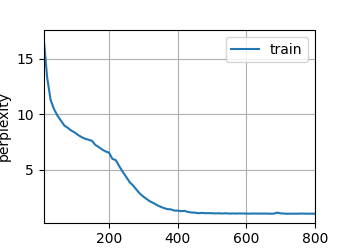
随机抽样
困惑度 1.3, 81862.0 词元/秒
time traveller held in his hand was a glitteringmetallic framewo
travellerit s against reason said filbywhat space as our ma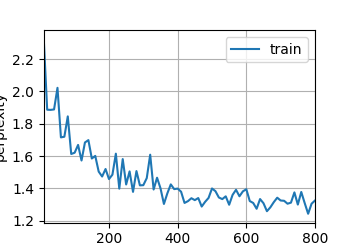
© 版权声明
版权声明
- 1本网站名称:MuQYY
- 2本站永久网址:www.muqyy.top
- 3本网站的文章部分内容可能来源于网络,仅供大家学习与参考,如有侵权,请联系站长 微信:bwj-1215 进行删除处理。
- 4本站一切资源不代表本站立场,并不代表本站赞同其观点和对其真实性负责。
- 5本站一律禁止以任何方式发布或转载任何违法的相关信息,访客发现请向站长举报
- 6本站资源大多存储在云盘,如发现链接失效,请联系我们我们会在第一时间更新。
THE END




暂无评论内容